
Maquila Regime in Paraguay 2026: Why Multinationals Are Relocating Production from Argentina
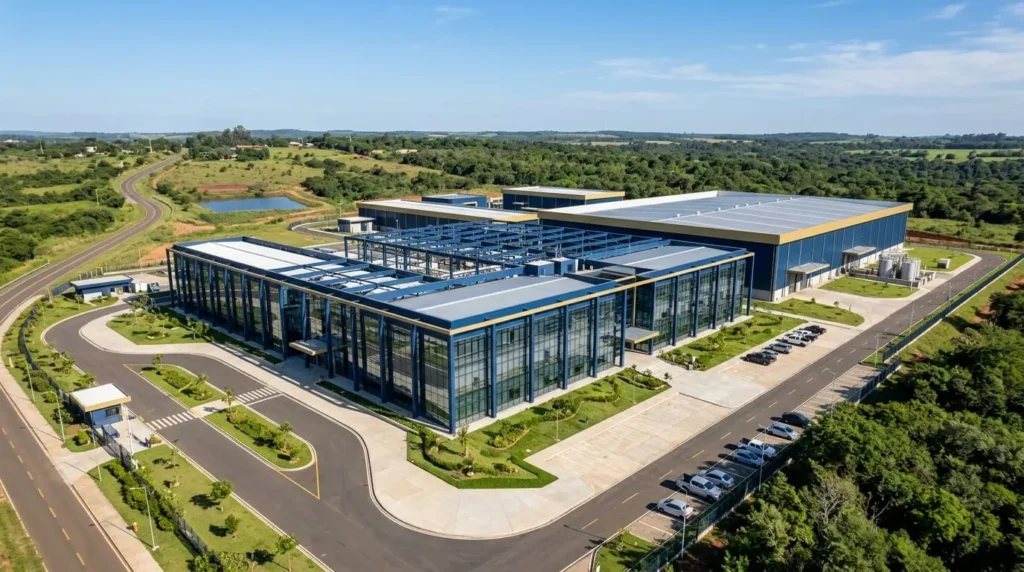
The Maquila Regime in Paraguay has consolidated in 2026 as the primary magnet for foreign capital fleeing regional instability. The recent announcement by Grupo Dass, representing brands such as Nike and Adidas, regarding its 40 million USD investment to install its industrial operations in Mariano Roque Alonso, is not an isolated event. It represents a structural trend where companies seek legal certainty and minimal fiscal pressure to maintain their global competitiveness.
Key Points of this Update:
- Investment of 40 million USD and the creation of 600 direct jobs.
- Total migration of machinery from plants in Buenos Aires to Paraguayan soil.
- Taxation of 1% on value-added under the maquila system.
- Preferential access to the MERCOSUR market with reduced operating costs.
The End of the Extractive Industrial Model: From Argentina to Paraguay
Dass’s departure from its plant in Coronel Suárez demonstrates that the Argentine productive environment has ceased to be viable for large-scale manufacturing. While industrial textile activity in the neighboring country suffered drops of over 20%, setting up a company in Paraguay offers a safe haven of macroeconomic stability. The Brazilian company is not only moving capital but its entire technical infrastructure to take advantage of the benefits of Law 1064/97.
Why does the footwear and apparel sector choose Asunción? The answer lies in predictability. The National Maquila Council has demonstrated bureaucratic agility that allows a plant to begin operations in record time, something unthinkable in other markets in the region. This efficiency directly impacts the return on investment (ROI) for foreign shareholders.
Comparative Fiscal and Operational Burden: Paraguay vs. Argentina
To understand the magnitude of the savings, it is necessary to observe the real numbers that executives at companies like DassTex face when making relocation decisions:
| Tax / Operational Concept | Argentina (2026 Context) | Paraguay (Maquila Regime) |
|---|---|---|
| Single Export Tax | Variable export duties | 1% on value-added |
| Corporate Income Tax | Brackets of up to 35% | Exempt under Maquila contract |
| Internal Taxes (Gross Income) | Higher than 5% (Provincial) | Does not apply (Tax suspension) |
| Social and Labor Charges | High complexity and litigation | Competitive cost and flexibility |
As can be seen, the difference is not just percentage-based; it is a paradigm shift in cash flow management. The tax system in Paraguay allows capital that was previously destined for national taxes to be reinvested in technology and production line expansion.
“The maquila is not just a tax incentive; it is an export platform shielded from the political fluctuations of neighboring countries,” state experts from the Ministry of Industry and Commerce (MIC).
Logistics and Strategic Location in Mariano Roque Alonso
The choice of Mariano Roque Alonso, close to the Silvio Pettirossi International Airport, is no coincidence. For a multinational that must import inputs and export finished products under high-value brands like Fila or Asics, proximity to logistics hubs reduces transit times and storage costs. This is a fundamental part of what it implies to live and operate in Paraguay: geographic efficiency in the heart of the continent.
Our Expert Perspective: The Rise of 360º Manufacturing
At ParaguayWay, we observe that the Dass case confirms that the country has moved beyond being just a destination for basic services. We are witnessing the consolidation of Paraguay as an advanced manufacturing hub. The approval of new projects by the National Maquila Council suggests that other sectors, in addition to textiles, are preparing their entry.
360º Case Study: Last month, a European investment group with interests in the auto parts industry consulted us about the viability of replicating the Dass model. Thanks to our comprehensive advisory services, we not only managed their Paraguayan residency and that of their key executives, but we also structured their business plan under the protection of the Maquila Law before the Ministry of Industry and Commerce. In less than 90 days, they achieved pre-approval to import machinery with zero tariffs, optimizing their initial Capex by 25% compared to their original idea of settling in Brazil.
What does this mean for you? That the window of opportunity to position yourself in a market with low competition and high profitability is open, but it requires impeccable technical execution to comply with DNIT regulations and avoid errors in the settlement of the single tax.
If your assets or company are in a high-tax jurisdiction, the Paraguay model offers a legal, ethical, and highly lucrative escape route. It is not just about saving taxes, but about ensuring the continuity of your business legacy in an environment that respects private property and fosters investment.
Are you ready to take the next step in your international expansion? let’s analyze your relocation case without obligation and discover how the Paraguayan legal framework can boost your profits this year.